

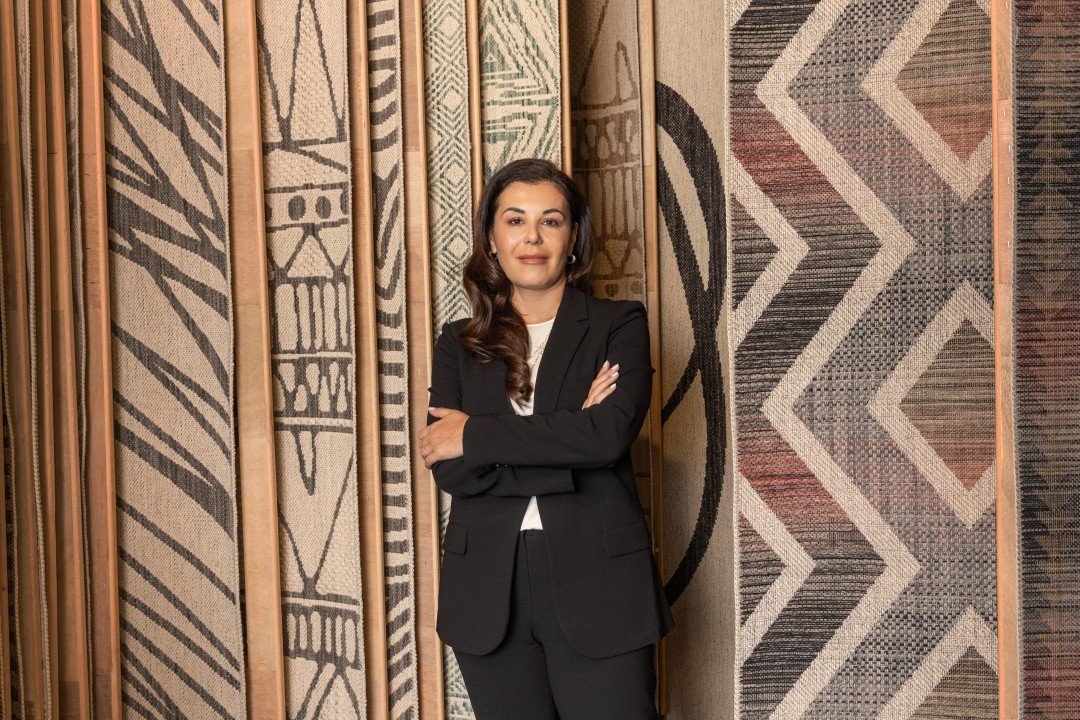
Egypt’s strategic geography, industrial capacity, and long-standing manufacturing expertise continue to position it as a global hub for trade and production, according to, who highlights the country’s unique combination of location, workforce strength, and export-driven industrial growth.
In this exclusive interview, Yasmine Khamis, Chair at Oriental Weavers Carpets, discusses Egypt’s investment potential, the evolution of its textile industry, the global expansion of Oriental Weavers, and how innovation, vertical integration, and cultural heritage continue to shape one of the world’s largest carpet manufacturing enterprises.
Egypt’s Strategic Geographic Advantage
For Khamis, Egypt’s greatest structural advantage lies in its geographic positioning at the intersection of global trade routes.
“Egypt is at the center of the world geographically located with a very attractive and growing labor force, with the Suez Canal, and with trade agreements across Africa, the Middle East and Europe.” Yasmine Khamis, Chair, Oriental Weavers Carpets
She highlights key national assets such as the Suez Canal, strong infrastructure, and a large, growing labor force as critical drivers of foreign direct investment.
Together, these factors position Egypt as a highly attractive destination for global manufacturers and investors seeking long-term industrial opportunities.
A Growing Hub for Foreign Direct Investment
Khamis believes Egypt is only at the beginning of a larger industrial transformation.
“It’s a very large market, very strategically located,” she says. “This is just the beginning of something that’s going to take us to a new world.”
She emphasizes that Egypt’s scale, workforce availability, and trade connectivity create a strong foundation for sustained foreign investment, particularly in export-oriented industries.
The Strategic Importance of the Textile Industry
The textile sector remains one of Egypt’s most historically significant and economically important industries.
According to Khamis, it is both deeply rooted in Egypt’s industrial history and highly relevant to its future development.
“The textile sector in Egypt is a very important sector historically and strategically,” she explains.
She notes that the sector benefits from labor intensity, which aligns well with Egypt’s demographic structure and industrial capabilities, making it a natural fit for large-scale manufacturing growth.
Oriental Weavers and Global Industrial Expansion
Khamis reflects on the remarkable growth of, which evolved from a small family operation into one of the world’s largest carpet and rug manufacturers.
“Oriental Weavers carpets started from a very modest beginning with simple machines run by a family,” she explains, “and evolved into the world’s largest manufacturer and leader of carpets and rugs worldwide.”
Today, the company operates across more than 118 countries and manages production across 26 factories, with further expansion underway.
For Khamis, this growth story reflects a combination of family-driven values, long-term vision, technological advancement, and a strong commitment to export markets from the outset.
Vertical Integration and Supply Chain Strength
A key competitive advantage for Oriental Weavers lies in its vertically integrated business model.
“We manufacture a lot of our raw materials,” Khamis explains. “We’re vertically integrated, which has enabled us to control our supply chain.”
This structure not only improves operational efficiency and global competitiveness but also supports sustainability and eco-friendly manufacturing practices.
By controlling multiple stages of production, the company is able to ensure consistency, scalability, and innovation across its global operations.
Innovation, Scale and Global Leadership
Khamis highlights several milestones that demonstrate the company’s global leadership in textile manufacturing.
Among them is the production of what was, at the time, the world’s largest rug — a 2 million square meter project completed in 2002, marking a major industrial achievement.
Today, Oriental Weavers produces approximately 114 million square meters of carpet annually, making it one of the largest production capacities in the global carpet and rug industry.
Cultural Heritage as a Driver of Design
Beyond industrial scale, Khamis emphasizes the importance of cultural identity and heritage in shaping product innovation.
Egypt’s long cultural history, including desert landscapes, nomadic traditions, and artistic heritage, serves as inspiration for design development.
“We use the design, the desert, the nomadic roots to really add on our innovation,” she explains.
The company also maintains an extensive design database of more than 4.5 million patterns, allowing it to respond to diverse global consumer preferences.
Global Reach and Export Strategy
Export orientation has been central to Oriental Weavers’ strategy since its inception.
Khamis notes that the company’s products are now present in over 118 countries worldwide, reflecting Egypt’s broader role as an export-driven manufacturing hub.
“We are working very hard to maintain that Oriental Weavers will be Egypt’s largest exporter,” she says.
This global reach reinforces Egypt’s position as a competitive manufacturing base capable of serving diverse international markets.
Egypt’s Long-Term Industrial Outlook
For Khamis, Egypt’s industrial future is anchored in a combination of geography, workforce strength, trade agreements, and manufacturing expertise.
She highlights Egypt’s growing network of trade agreements across Africa, the Middle East, and Europe as an additional advantage supporting export expansion.
Ultimately, she believes Egypt is uniquely positioned to continue expanding its industrial footprint globally while leveraging both its heritage and its modern manufacturing capabilities.
Closing Perspective
Egypt’s textile industry and manufacturing ecosystem, as exemplified by Oriental Weavers, reflect a broader national trajectory of industrial scaling, global integration, and export-led growth.
For Khamis, the future remains focused on maintaining global leadership, expanding production capacity, and reinforcing Egypt’s position as one of the world’s key manufacturing and trade hubs.
#YasmineKhamis #OrientalWeavers #Egypt #TextileIndustry #Manufacturing #ExportGrowth #SuezCanal #FDI #IndustrialDevelopment #GlobalTrade #SupplyChain #VerticalIntegration #AfricanManufacturing #MiddleEastEconomy #SIMfilms
